
Parke County Deed Types
The Parke County Recorder preserves deeds and other land instruments. A deed records the transfer its parties claim, nothing more. It will not spell out every right or defect attached to the land. Type, names, legal description, filing date, and reference number matter. These are what separate one transfer from the next.
| Deed Type | What It Does | Common Use |
|---|---|---|
| Warranty deed | Conveys the stated interest with title promises | Ordinary sale |
| Quitclaim deed | Conveys only the interest the signer may hold | Family transfer or cleanup |
| Personal representative deed | Conveys land through an estate representative | Probate or estate sale |
| Sheriff or tax deed | Records a transfer from a legal or tax process | Foreclosure or tax sale |
| Trustee deed | Conveys an interest through a trustee | Trust administration |
Many instruments share the Recorder's filing system. A mortgage secures debt; a release proves a discharge. Liens, leases, easements, bankruptcy notices, and plats live there too, and an easement can burden land without ever changing the fee owner of record.
Parke Deed Index Cutoffs
Doxpop's county partner table lists two cutoff dates for Parke County deed records. Index data begins in March 1996. Scanned images begin in December 2006. A search can therefore return an index entry for an older deed while offering no image online.
Treat Doxpop as a starting point, not the archive. Older deeds may sit in Recorder books or microfilm. A failed name query does not prove no deed exists, since spelling variants, initials, entity names, date ranges, and legal-description terms all shape what comes back.
The recorded-document entry screen is the public access point for those queries in participating counties.
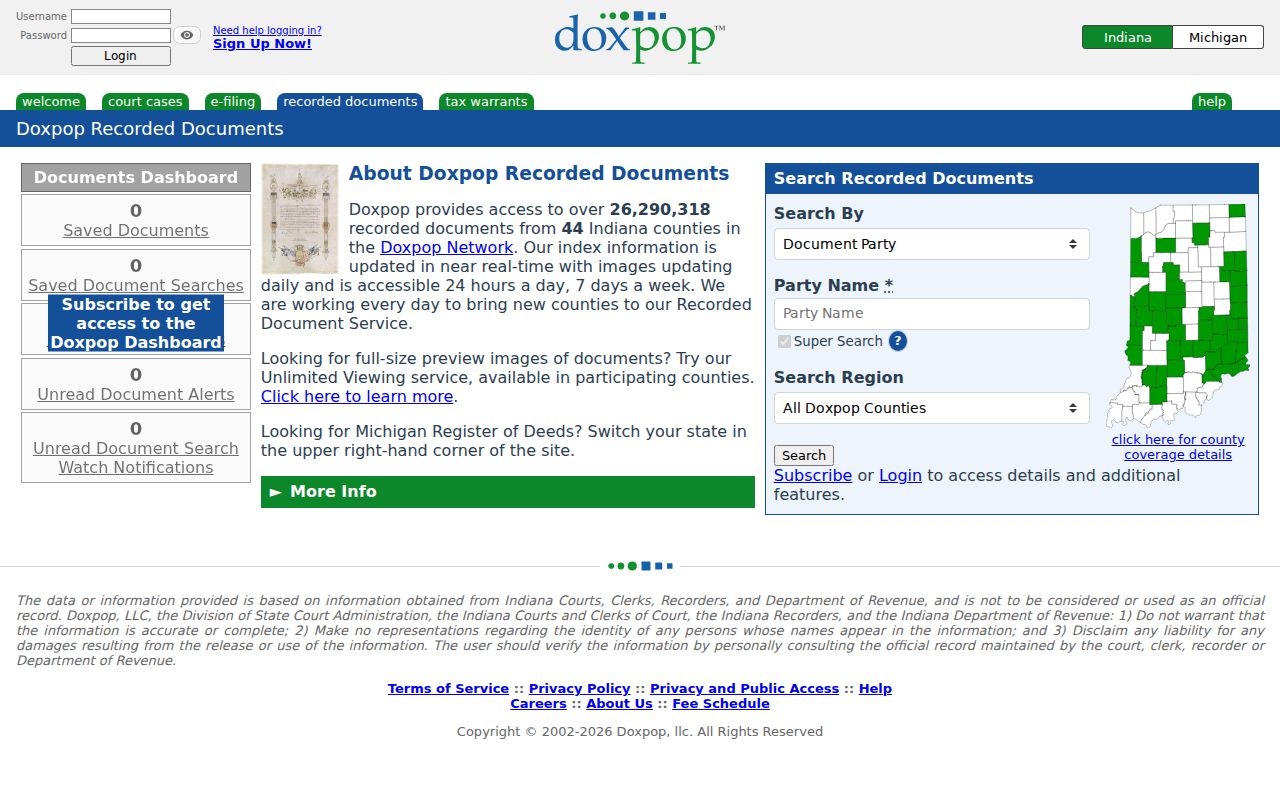
Apply the Parke County filter before trusting any result. Then confirm the entry against the Recorder's copy.
Note: Index and image coverage start on different dates, so an index hit without an online image is normal for part of Parke's run.
Search Parke Deeds in Doxpop
The advanced recorded-document search combines parties, dates, document details, and land terms in one query. Platted land matches best by subdivision, block, and lot. Unplatted tracts turn on township, range, section, and quarter descriptions.
| Search Control | Format | Best Use |
|---|---|---|
| Region or county | Dropdown | Limit results to Parke County |
| Party name | Name text | Find grantors, grantees, lenders, or entities |
| Legal description | Land-description groups | Match the tract across name changes |
| Document information | Text and type controls | Narrow deeds, easements, or releases |
| Recorded dates | From and to dates | Reduce a broad result set |
| Sort and filter | Result controls | Order by party, date, or public ID |
Full-text search inspects indexed notes and OCR text. Older scans can defeat OCR, so run party and legal-description searches too; Doxpop itself warns that county-fed data can lag or miss entries.
Build Parke's Grantor Chain
A grantor gives an interest. A grantee receives it. The chain of title is the ordered run of transfers tied to one tract, so start at the newest reliable instrument and work backward.
- Find the current parcel number and legal description in the county property record.
- Search the current owner as grantee and open the newest likely deed.
- Record grantor, grantee, date, reference, deed type, and land description.
- Search that grantor as a grantee in an earlier date range, then match the tract.
- Repeat until the cutoff, then move to books, microfilm, or the counter.
- Grantor
- The party conveying the stated interest.
- Grantee
- The party receiving the stated interest.
- Book and page
- A volume and page reference.
- Instrument number
- A unique filing or public ID.
- Chain of title
- The linked sequence of land transfers.
Deed chains fit inside a wider hunt. The Parke County property search covers addresses, owners, and parcels. For tracing a chain, the legal description beats road names and parcel numbers, since both can change over time.
Read Parke Deed Results
A Doxpop result can display public ID, county, recording date, document type, indexed parties, and legal text. A public ID may open details or an image. The example uses a vendor-format record from another county, so it shows the layout rather than a Parke transaction.
Check every role and tract clue. One row can list several parties. A quitclaim deed and a mortgage may sit near the same date yet mean very different things. The legal column often carries lot and subdivision instead of a street address.
The recorded-document search endpoint handles these queries.
Result fields form a trail of references. The parcel number, grantor, and deed book page point back to the recorded instrument.
They do not replace the deed itself. Its wording, signatures, exceptions, and legal description control.
Parke Deeds Before the Web
Parke County was organized in 1821. A courthouse fire in 1833 destroyed deeds and probate records predating that year. No portal can restore what did not survive.
The Indiana State Library microfilm inventory lists deed index A through 22. These cover 1823 through 1924. Deed record volumes 1 through 65 cover 1833 through 1901. Mortgage indexes and books appear too. Recorder holdings, State Library film, and land entries can bridge parts of a long study. The fire may still leave a break.
The online-deed myth. A Doxpop miss is not proof that no Parke deed exists. Check county books and microfilm when the date or spelling falls outside the online path.
Note: A surviving index starting in 1823 does not mean every early deed instrument survived the 1833 courthouse fire. Verify early entries against the original books.
Parke Liens and Easements
A chain looks clean if you read only deeds. The Recorder also keeps mortgages, liens, leases, easements, plats, releases, satisfactions, and notices. Search by party and by land description, then pair each charge with a later release when one exists.
An easement may be indexed under the granting party rather than the current owner. A lis pendens signals pending land litigation. A judgment or mortgage may need its own satisfaction. Court proceedings run through MyCase and the Clerk, but the recorded notice or resulting deed belongs in the Recorder trail.
Group your working file by date and legal description.
Obtain Parke Deed Copies
The Parke County Recorder works from Room 102 at 116 West High Street in Rockville. Weekday hours run from 8:00 a.m. to 4:00 p.m. Call 765-569-3419 ahead when you need an older book, a large plat, or a certified copy. A document number or a book and page reference speeds the counter visit.
Online images are only one channel for Parke County deed records. Public search terminals and county books at the office remain the main fallback. A quick phone call can confirm what the office holds. A mail request should name the parties, a date range, the document type, the legal description, and any reference you have. When routine access does not resolve a request, an Indiana Access to Public Records Act request under Ind. Code § 5-14-3 may identify an existing record described with reasonable particularity.
Costs are simple to estimate. Doxpop's glossary notes that Indiana recorders charge $1 per reproduced page. Parke County does not publish a complete certification schedule online. Confirm the total with the office before ordering.
Recorded is not guaranteed title. Filing shows what reached the public record. It is not a legal opinion, and unrecorded interests or indexing errors may exist.
Extend Parke Land History
Deeds are not the only paper trail in town. The Parke County Public Library genealogy room holds more than 300 microfilms, census records from 1830 through 1930, newspapers, Quaker meeting records, cemetery sources, wills, veteran burial records, and an obituary index running through 2020. Those sources can explain who lived on a parcel. They also show how families connect and how estates passed down. They are clues, though, not substitute deed records. Match a directory listing, obituary, census entry, or newspaper item to a recorded transfer. Settle no question about who owned the land without it.