
Identify Who Owns Parke County Property
A careful Parke County property search starts with the land itself. It then moves to the official filing trail. ParkeIN Think GIS takes an address, an intersection, a parcel number, or an owner name. Open the parcel card. Read the owner string next to the parcel's situs, or physical, address. The Auditor tax list makes a strong second check. It searches by parcel, name, property address, district, and tax year. Neither tool replaces the deed itself.
- Enter the situs address in ParkeIN Think GIS. Select the matching parcel and copy its owner name, parcel number, mailing address, and legal-description shorthand.
- Compare the parcel in the Parke County Auditor tax list. If the parcel was split or combined recently, try the owner's last name as the Auditor advises.
- Search the current owner as a grantee in the Recorder's Doxpop index. Match the legal description, recording date, document type, and public ID to the parcel.
- When a trust, estate, or company appears, keep that exact owner string. Search related trustees or representatives only to understand the filing, not to replace the named grantee.
The parcel number is what ties everything together. Parke County examples follow an 18-digit-style format, though an older reference number may appear too. Copy the punctuation exactly as the live record shows it. That discipline flags the right tract. It also cuts down on same-name mistakes.
Parke County Ownership Sources
Three public systems each answer a different piece of the ownership question in Parke County. The Assessor's roll describes the parcel for appraisal. The Recorder preserves every accepted instrument. GIS links the parcel card to a spot on the map. The Auditor keeps its own list as well. That list can surface an owner, district, parcel, related number, and situs address.
| Where ownership appears | What it gives | How current |
|---|---|---|
| ParkeIN Assessor card | Owner-of-record string, mailing and situs addresses, parcel and possible transfer fields | Current assessment roll; refresh timing is not published |
| Auditor tax list | Name, parcel, district, property address, tax year and related parcel clues | Live tax list; split or combined parcels may need a last-name search |
| Recorder / Doxpop | Latest deed's grantee, grantor, document type, date, public ID and legal description | Accepted recording is the transfer check; remote index begins March 1996 |
| Think GIS map | Parcel location and the card attached to the mapped tract | Reference display assembled from county data, not a title opinion |
Going online is not the only route. The Recorder's counter and bound books sit in the courthouse in Rockville, open on weekdays during posted courthouse hours, and reachable at 765-569-3419. Older deeds also survive on State Library microfilm. Those channels fill the gaps when a name or image never made it online.
Read Parke County Owner Addresses
Two addresses travel with every parcel. The situs address pins down the land itself. The mailing address is where tax-roll notices go. They often match, but they don't have to. A rural Parke County parcel can even carry a postal city that differs from the nearby town or taxing unit. Keep the limits in mind. A separate mailing address does not prove the owner lives elsewhere, and a situs address says nothing about who actually occupies the property.
- Owner of record
- The person or entity named on the county roll at the time the data was posted.
- Grantee
- The party receiving an interest in a recorded deed.
- Situs address
- The physical address assigned to the parcel, used to locate it in the assessor and GIS records.
- Mailing address
- The correspondence address on the tax roll; it is not proof of residence.
- Title
- The legal interests in land, which can require more than one public database to evaluate.
For a lawful property matter, that mailing line on the tax roll can serve as a contact route. Keep any inquiry tied to the parcel. An address alone reveals nothing about a resident, a relationship, or personal history.
Confirm a Parke County Property Owner
The Recorder is the legal filing office for property records in Parke County. It handles deeds, mortgages, liens, leases, plats, and related instruments. Doxpop provides remote access. Its Parke County partner data states that index coverage begins in March 1996 while scanned images begin in December 2006. So a hit can name a document yet offer no image. An older ownership record may still exist even when a remote deed search returns nothing. Run the assessor's exact owner string as the grantee. Narrow the results to Parke County and a date range. Compare the legal field against the parcel card. A Doxpop result may list public ID, county, date, type, indexed names, and the legal description. When only the index is there, the Recorder counter can produce the official instrument. The full mechanics of an accepted filing appear on the Parke County deed records page. Doxpop's recorded-document entry serves as the remote gateway for that confirmation step.
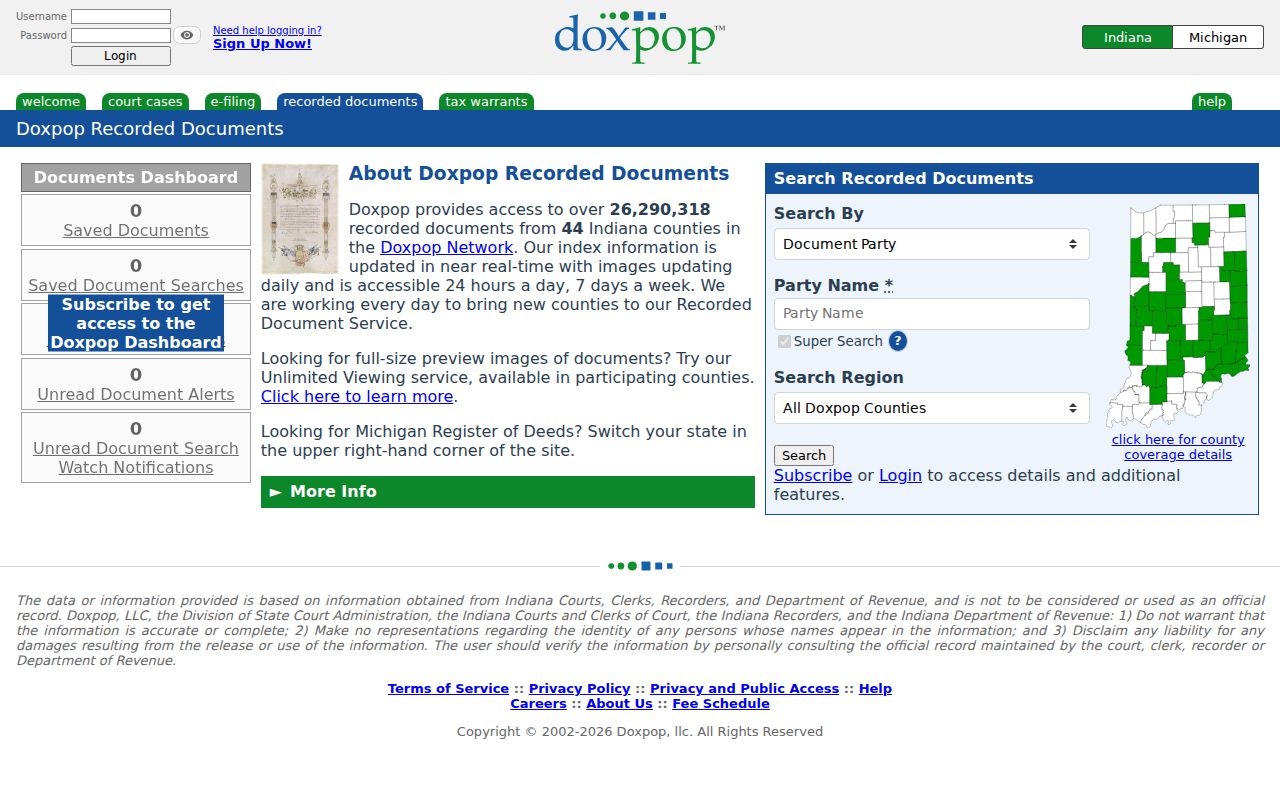
The gateway is not a rendered Parke transaction. Use it to reach the index, then verify the county, party, date, and legal-description fields before trusting any result.
Parke County Trust and LLC Owners
Parke County ownership is not always a person. The roll may name a trust, trustee, limited liability company, corporation, estate, or personal representative. Keep the punctuation and suffix exactly as written. With a trust, search both the trust name and the trustee. With an estate, search the decedent and the representative in the deed index. Turn to the Parke Circuit Court probate record when needed. The deed itself may spell out life-estate or survivorship terms that the assessor string compresses. For a company, the Indiana INBiz business search can confirm the legal entity. It also lists the registered agent and the office address. That corporate record still does not prove land title. The Recorder deed remains the transfer evidence. The parcel's legal description is what keeps a business-name match anchored to the right ground.
Note: Search alternate initials, former names, entity suffixes, and representative names only when the parcel or legal description confirms the match.
When Parke County Ownership Lags
A fresh closing can leave the sources briefly out of step. The accepted deed names the new grantee. The assessment card still shows the former owner. Parke County publishes no fixed WTHGIS refresh interval, so assume no number of days. Within that narrow gap, compare recording dates. Lean on the newest accepted deed to confirm the transfer.
Fresh filing rule. The assessment roll can lag a recent sale. The newest recorded deed is the more current transfer record.
A parcel split or combination creates a second kind of mismatch. The Auditor specifically advises searching by last name. A change occurred within the prior two years is when this matters most. Review every returned parcel instead of grabbing the first bill or card. Parent, child, inactive, and old reference numbers can all preserve a link. That link connects a former parcel to its present pieces.
Parke County Estate Transfers
A deceased owner's name can stay on the tax roll long after death. The lag ends once a transfer is recorded and assessment data catches up. Watch the deed records for the instruments that move an estate. These include a personal representative deed and a beneficiary or transfer-on-death instrument. A surviving-joint-tenant affidavit, a surviving-spouse affidavit, or a trustee deed may also appear. Probate papers can affect the parcel, too. In that case, the Parke Circuit Court and Clerk file holds the will, the appointment, the inventory, any sale order, and the final accounting.
Indiana MyCase lets anyone search public, non-confidential cases by party, case, or attorney. It is not a land index. A probate name and county can point toward the right file. Still, the deed tells you more. Its legal description and grantee give the surest bridge back to the parcel number in Parke County property records.
Watch Parke County Owner Filings
Doxpop runs a Property Watch service that sends alerts tied to recorded documents, though Parke County publishes no dedicated enrollment page for it. An alert is only a prompt. Inspect the official record before drawing conclusions about whether a filing is valid or false. For a property owner, a watch service can flag an unexpected name or instrument sooner than a yearly tax bill would.
Verify directly. Write down the document ID, the recording date, the parties, and the legal description. Then contact the Parke County Recorder through its official county listing. Never rely on a marketing email or an unsolicited caller's number to settle the matter.
Limits of Parke County Owner Lookups
A parcel card answers one narrow question: whose name does the assessment roll carry? It does more limited work than people assume. The card cannot identify every person with a legal interest. It cannot prove who occupies the site. It cannot surface an unrecorded claim. Easements, life estates, liens, and survivorship rights often require the deed. Trust terms often do too, along with other recorded instruments. A full title opinion needs a professional examination of the chain and its exceptions.
Indiana's Address Confidentiality Program shields qualifying participants in specified public records, including protected voter data. That protection matters. It is one more reason not to treat public databases as a complete personal directory. Put ownership facts to a lawful property purpose instead. That could be a purchase, a boundary question, an estate task, or a deed-fraud check.
Use records lawfully. A Parke County property owner name is not a title search and must never be used to stalk, harass, or harm anyone.