
Trace Former Parke County Owners
Build the chain one transfer at a time. Treat any timeline table as scaffolding, not as real people or invented transactions. Fill each row only from a recorded instrument whose legal description matches the subject tract.
| Transfer date | Grantor to grantee | Deed type | Book/page or public ID |
|---|---|---|---|
| Newest accepted deed | Present owner's seller to present grantee | As indexed and recorded | Current instrument reference |
| Prior matching deed | Earlier owner to that seller | As recorded | Earlier instrument reference |
| Next earlier transfer | Prior grantor to prior grantee | As recorded | Book/page in older runs |
The legal description is the control. An address may have been renumbered. Lot, block, subdivision, or township-section-range details keep former owners tied to the same land even when a parcel number changes after a split.
Reconstruct Parke County's Deed Chain
Start with the parcel card and the most recent deed. Doxpop's Parke County index can be searched by party name or legal description. It also covers document details, county or region, instrument type, and date range. A street address alone is a weak key for the Recorder. Convert it first to an owner, parcel number, and legal description through WTHGIS. The Auditor list works too. Then the deed search stands on firm ground.
- Find the latest deed with the current owner as grantee. Record its public ID or book/page, date, deed type, grantor, and legal description.
- Take that grantor, who is the previous owner in this transfer, and search the earlier period for the deed where the same party was grantee.
- Compare the legal description. If it matches, record the earlier grantor and repeat. Search initials, married names, entity suffixes, trustees, and representatives when needed.
- At the remote cutoff, continue in the Recorder's books or the Indiana State Library microfilm index. Do not treat an online miss as the end.
- Grantor
- The party conveying an interest.
- Grantee
- The party receiving an interest.
- Chain of title
- The linked sequence of instruments affecting the same tract.
- Reverse index
- An index organized to help follow names in the opposite party role.
- Warranty and quitclaim
- Different deed forms; neither label alone proves that every title issue was resolved.
Treat OCR and full-text search as leads, not guarantees. Doxpop warns that older text recognition can be weak. A name plus the full tract description beats a loose surname match every time.
Parke County's Online Owner Cutoffs
Parke County index data in Doxpop begins in March 1996. Scanned images start later, in December 2006. An indexed transfer can therefore lack an online image, and a deed recorded before the cutoff may be missing from remote results even though the county book survives. Plan for both limits.
Online limit. Parke County's remote index starts in March 1996 and images in December 2006; older prior owners require books or microfilm.
The Recorder counter is the first stop after that. The office at 116 West High Street, Room 102, Rockville keeps Monday through Friday hours of 8:00 a.m. to 4:00 p.m. Call 765-569-3419 with a document reference, party names, and the legal description. Staff will not do the title search.
Review Parke County Prior Deeds
The Doxpop recorded-document result route is the remote starting point for post-cutoff previous owners.
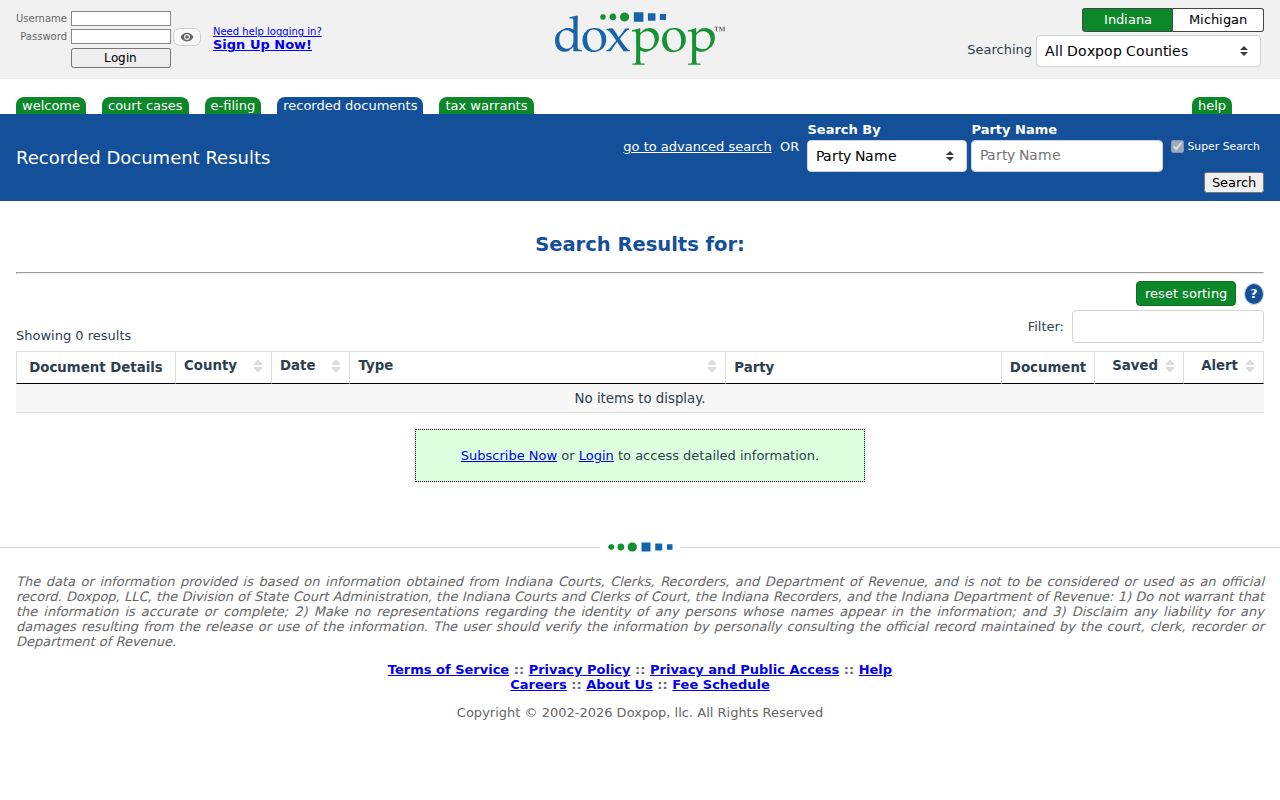
Use the search screen only to enter the index. Then match county, party roles, date, and legal description before trusting a hit.
Older Parke County Owner Books
The Indiana State Library microfilm inventory is unusually precise. Deed Index volumes A through 22 cover 1823 through 1924. Deed Records volumes 1 through 65 span 1833 through 1901. Mortgage indexes run from 1826 to 1891, and mortgage books from 1840 to 1889. A prior-owner search can continue past Doxpop through these series. Party and book references carry through each step.
The State Library's Parke microfilm finding aid maps those runs. The Recorder's county books matter too, alongside State Library reading-room material. Copies of a single recorded instrument follow a different route. The separate Parke County deed records resource is the better stop. Ownership history is about how the names connect.
The 1833 Parke County Break
Parke County was organized in 1821. The courthouse burned in 1833. The Indiana State Library reports that deeds and probate records from before the fire were lost. That is a real break in the source trail. An index volume starting in 1823 cannot restore an original deed the fire destroyed.
Early work may shift to Land Entries, the Land Entry Book, post-fire deeds, later instruments that recite older facts, probate evidence, maps, and newspapers. These sources can support a careful property history. The gap itself belongs in the conclusion.
Prior Parke County Owners in Probate
The chain breaks where land passed at death. Look for personal representative deeds, beneficiary and transfer-on-death instruments, surviving-joint-tenant affidavits, surviving-spouse affidavits, and trustee deeds. Then check the Parke Circuit Court or Clerk file. The file may hold the will, appointment, inventory, sale petition, order, and final accounting.
State Library microfilm includes an Index to Estates from 1833 through 1981, will books through 1936, and probate order-book runs reaching into the twentieth century. A will or order can explain an inheritance. The later deed then reconnects that event to the Recorder chain. Keep the legal description in view throughout. Estates often hold more than one parcel.
Map Former Parke County Owners
Recorded plats and landowner maps steady a tract when names change. Parke descriptions include platted forms like half lots and blocks. Rural land uses township, section, range, quarter, or metes-and-bounds wording. A map is an index aid, not the conveyance.
The State Library lists Parke plat books from 2003, 2010, 2012, and 2014. Each carries township, city, highway, and landowner-index content. Its holdings add a 1925 Hixson plat atlas. Compare editions to spot a likely owner or parcel shift. Then return to the deed. Sanborn maps of Rockville and Rosedale and local newspapers add street and building context. They never replace the recorded chain.
Note: Parke County's Plat Office page says “Coming Soon,” so current routing may require Planning and Zoning, Recorder, or Surveyor.
Enrich Parke County Ownership History
The Parke County Public Library holds more than 300 microfilms. Its collections cover newspapers, Quaker meeting records for Rush Creek and Bloomingdale, and census material from 1830 through 1930. They also include cemetery records, wills, and an obituary index running through 2020. These materials shine in tricky cases. They help when two Parke County owners share a name. They also explain an estate, road change, or family transfer.
Bring them in only after the deed framework is solid. A census line, obituary, or church record can place someone near a parcel. That alone does not prove the person held title to it. The strongest house histories keep recorded former owners separate from mere occupants and family clues.
How Far Parke County Owners Go
Tracing owners in Parke County can stretch across several channels. The remote index comes first, then Recorder books, then State Library microfilm. A chain ends when the evidence runs dry. The 1833 destruction can interrupt it too. Records sometimes go missing online. That simply means you should try the next channel. Do not assume no deed exists. Where a documented fire destroyed original records, label the break as a gap in the chain.
People search Parke County property records for many reasons. Title work, estate questions, purchase diligence, and plain curiosity about a tract's history all drive the effort. Remember that a chain built from indexes is not a title opinion. Verify each instrument, and get professional help when legal ownership or insurability is at stake.
Lawful use. Prior-owner records support property history. Never use a living person's name or address to stalk, harass, or cause harm.